
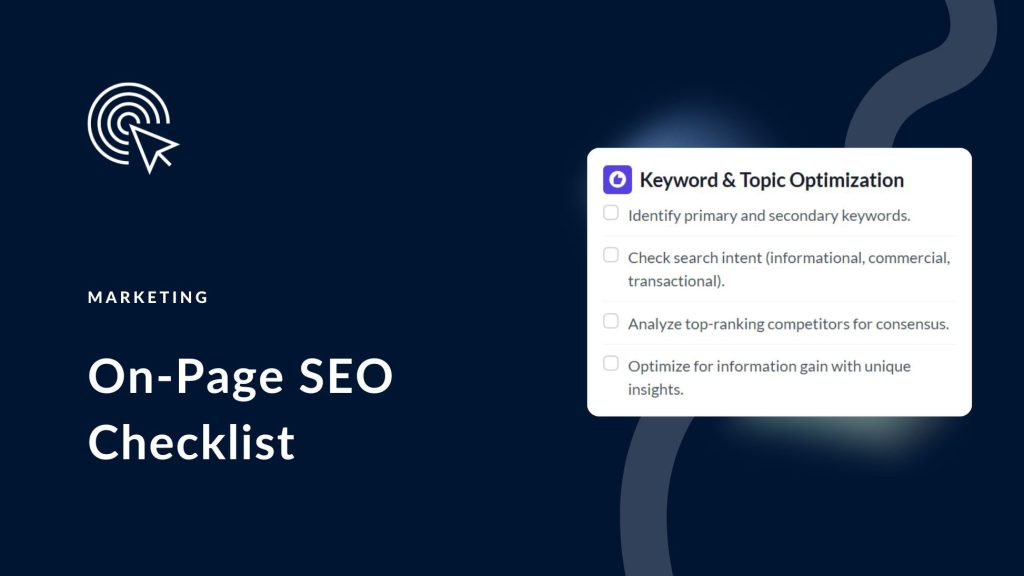
First, honestly answer this question. When was the last time you clicked a blue link on Google? For a lot of people, the answer is “not today.” AI tools now read the web and hand back answers directly. That changes things. The following full SEO checklist for AI search is built for that new world. It covers the old basics that still matter, plus a few newer steps made just for AI search. By the end, you’ll know exactly what to check on your own website before you hit publish. Just a clear list you can actually use.
What Is On-Page SEO?
On-page SEO means fixing the parts of your website you control directly. Your titles, headings, and words on the page. It’s different from off-page SEO, which is about other sites linking to yours. Think about it like cleaning your own room versus asking neighbors to say nice things about you. Both matter. But on-page SEO is the part you can start today, with no one else’s help. A solid on-page SEO checklist gives you a clear order to do the right things, so nothing important gets skipped.
Why On-Page SEO Matters More in 2026
AI Overviews now show up on nearly half of all Google searches, based on recent tracking of search results. That’s a huge shift from just a year or two back. So your page isn’t just competing for a spot on page 1 anymore. It’s competing to be the source an AI tool quotes. That’s a different game, and this on-page SEO checklist is built with that game in mind. Old-school SEO advice still applies, mostly. But a real SEO checklist for AI search needs a few extra habits layered on top too.
How Do You Pick the Right Keywords?
Keywords are just the words people type when they’re looking for something. If you sell handmade candles, someone might type “soy candles for allergies.” That phrase is a keyword. Simple as that. Picking the right ones is where a lot of beginners trip up. They chase big, broad terms nobody realistic can rank for. A new site trying to rank for “candles” is fighting giants. A more specific phrase gets you ranked faster.
Simple Ways to Find Good Keywords
Type your topic into Google and look at the autocomplete suggestions. Scroll down to “related searches” too. These are real phrases real people search. You don’t need fancy software to start. A notepad and some patience work fine at first.
What Is Search Intent?
Search intent is the reason behind the search. Someone typing “best running shoes” wants to compare options. Someone typing “buy running shoes size 9” wants to purchase right now. Match your content to that reason, or readers will bounce straight back to Google. This step alone can make or break an on-page SEO checklist that otherwise looks perfect on paper. Get this part wrong, and nothing else matters much. A beautifully written page answering the wrong question still won’t rank.
What Makes a Title Tag and Meta Description Work?
Your title tag is the blue headline shown in search results. Keep your main keyword near the front. Also keep the whole title under 60 characters, or Google might cut it off mid-sentence, which looks messy. The meta description sits just below the title. It won’t directly boost your ranking. But a good one gets more clicks, and more clicks over time can help your page anyway. Stay under 160 characters. Mention what the reader will get. Add a small reason to click, something a competitor’s boring description skipped.
How Should You Structure Headings for Google and AI Tools?
Every page needs one H1. That’s your main title. Under it, use H2s to break the page into sections. Inside those, H3s handle smaller pieces. This isn’t just neat formatting. It’s a map. Search engines and AI tools both use that map to figure out what your page actually covers. A page with no headings, just one giant wall of text, confuses everyone. Readers skip it. AI tools skip it too, because there’s nothing clear to grab and quote. A good heading structure seems small until you compare two pages side by side. The one with clean headings almost always wins. It’s an easy win, and it belongs early on any solid on-page SEO checklist.
Use Questions People Actually Ask
Try turning some of your H3s into short questions people type into Google. “How long does shipping take?” works better than a vague heading like “Shipping Info.” AI tools are built to answer questions, so headings shaped like questions get pulled into answers more often. This one trick alone belongs near the top of any good on-page SEO checklist.
Why Do Your First 100 Words Matter So Much?
Here’s something most beginners miss completely. Whatever you write in the first hundred words often becomes the exact text an AI tool copies into its answer. So don’t bury your main point in paragraph four. Say it early. A strong opening answer sounds something like this, made up as an example: “A slow cooker roast usually needs six to eight hours on low heat, depending on the size of the cut.” Short and direct.
Something that stands alone even if nothing else on the page gets read. Aim for something in the 40 to 60 word range, sitting right near the top of your page. This single habit is one of the biggest differences between an old-style on-page SEO checklist and a true SEO checklist for AI search built for how people actually search today. Test it yourself. Read only the first two sentences out loud. Does it answer the main question? If not, rewrite it first.
How Do Images and Links Help Your On-Page SEO?
Images do more than decorate a page. They give context, and also slow your site down if you’re not careful. Links, on the other hand, connect your content to the wider web and to your own other pages.
Alt Text and Image Names
Alt text is a short written description attached to an image. Screen readers and search engines use it, since they can’t actually “see” a picture the way a person does. Rename your image files with real words instead of leaving them as random numbers and letters. A file called blue-ceramic-mug.jpg tells a search engine far more than IMG4821.jpg ever could.
Internal and External Links
Internal links point to other pages on your own site. They help visitors explore more of your site. And help search engines understand how your pages connect to each other. External links work differently: they point outward, out to other trusted sites. Here’s the thing beginners get wrong a lot. They think linking out sends people away, so it must hurt you somehow. It doesn’t.
Linking to solid, well-known sources actually builds trust. It shows you’re not hiding in a corner, you’re part of a bigger web of good information. Use both kinds in the right spots and your page gets more useful. Your on-page SEO gets stronger too. You don’t need a ton of links. A few internal ones, one or two external ones pointing to trusted places, that’s usually enough for most pages.
What Is Schema Markup and Do You Really Need It?
Schema markup sounds technical, but the idea is simple. It’s a label hidden in your page’s code that tells search engines exactly what kind of content is on that page. Is it a recipe? A review? A blog post? Schema spells it out simply instead of making the search engine guess. You don’t need to be a coder to use it. Many website builders add schema automatically or offer a simple plugin. One kind worth knowing is FAQ schema, which flags your questions and answers so they can appear directly in search results. It’s a small addition that quietly strengthens your on-page optimization AI efforts behind the scenes, even though nobody visiting your page will ever notice it’s there.
How Do AI Tools Like ChatGPT Read Your Website?
This part trips up a surprising number of site owners doing on-page optimization AI work for the first time. AI tools send out their own little robots, sometimes called crawlers, to scan websites. GPTBot, PerplexityBot, and ClaudeBot are three examples. If your site accidentally blocks them through a file called robots.txt, you become completely invisible to those tools. Go check that file. It usually sits at yourdomain.com/robots.txt. If you see broad blocking rules aimed at “all bots,” you might be locking out helpful AI crawlers by mistake, without realizing it.
There’s also a newer idea worth knowing about: a file called llms.txt. Think of it like a simple welcome note for AI tools, pointing them toward your best content. Right now, only a small slice of websites have actually set one up, so adding yours today puts you ahead of most of the web. Building this kind of awareness into your SEO checklist for AI search puts you ahead of most competitors who haven’t even heard the term yet. Most business owners never hear about this, which is why good websites stay invisible to AI tools without anyone knowing why. Your on-page optimization AI work is wasted if crawlers can’t get in the door.
Why Mobile Speed and Trust Still Matter
Google mostly looks at the mobile version of your site now, not the desktop one. So if your page loads slowly or looks broken on a phone, that’s the version getting judged. Test your pages and fix anything flagged as slow. Trust matters just as much. Show a real author name. Keep information current instead of letting old stats sit there for years. Small trust signals like these round out a genuinely complete on-page SEO checklist, the kind that covers both machines and the humans reading your page. Fix the slowest, oldest pages first, then work down the list.
Conclusion
A good on-page SEO checklist isn’t about doing everything perfectly on day one. It’s about steadily covering the basics, then layering in the newer AI-focused habits as you go. Titles, headings, clear early answers, and open crawler access are all core parts of solid on-page optimization and AI work. None of it is complicated once you break it down piece by piece. If all this still feels like a lot to manage alone, that’s normal. Teams like Brighton Ashbury Digital Marketing Agency USA spend their days deep in exactly this kind of work, helping small business sites become both search-friendly and genuinely useful to real readers. Start with a few steps from this list today, and build from there.
Why isn’t my website showing up on Google even after I did SEO?
Usually it’s a mix of small issues rather than the big one. Maybe your keywords are too broad, your site loads slowly, or a setting is accidentally blocking search engines. Go back through each step above one at a time.
What is the difference between on-page SEO and technical SEO?
On-page SEO is what you see and write. Titles, headings and the actual words on the page. Technical SEO lives behind the scenes such as: site speed, mobile setup. Whether search engines can even crawl and read your pages properly. They’re not the same thing. But one without the other falls apart pretty fast.
Do I need expensive tools to do on-page SEO?
Not really. When you’re just starting out, use free tools to get the job done fine at first. Google’s own free tools, like Search Console and PageSpeed Insights, cover a lot of ground. Paid tools help later, once your site grows and you want deeper keyword data.
How long does on-page SEO take to show results?
Most new sites wait somewhere around six to twelve weeks before seeing real movement. It’s slow at first, then it tends to build. Patience matters more than people expect going in.
Can AI tools like ChatGPT send traffic to my website?
Yes, when your content gets cited or quoted inside an AI answer. That’s the whole point of a real SEO checklist for AI search: writing clear, direct answers near the top and keeping AI crawlers unblocked.